
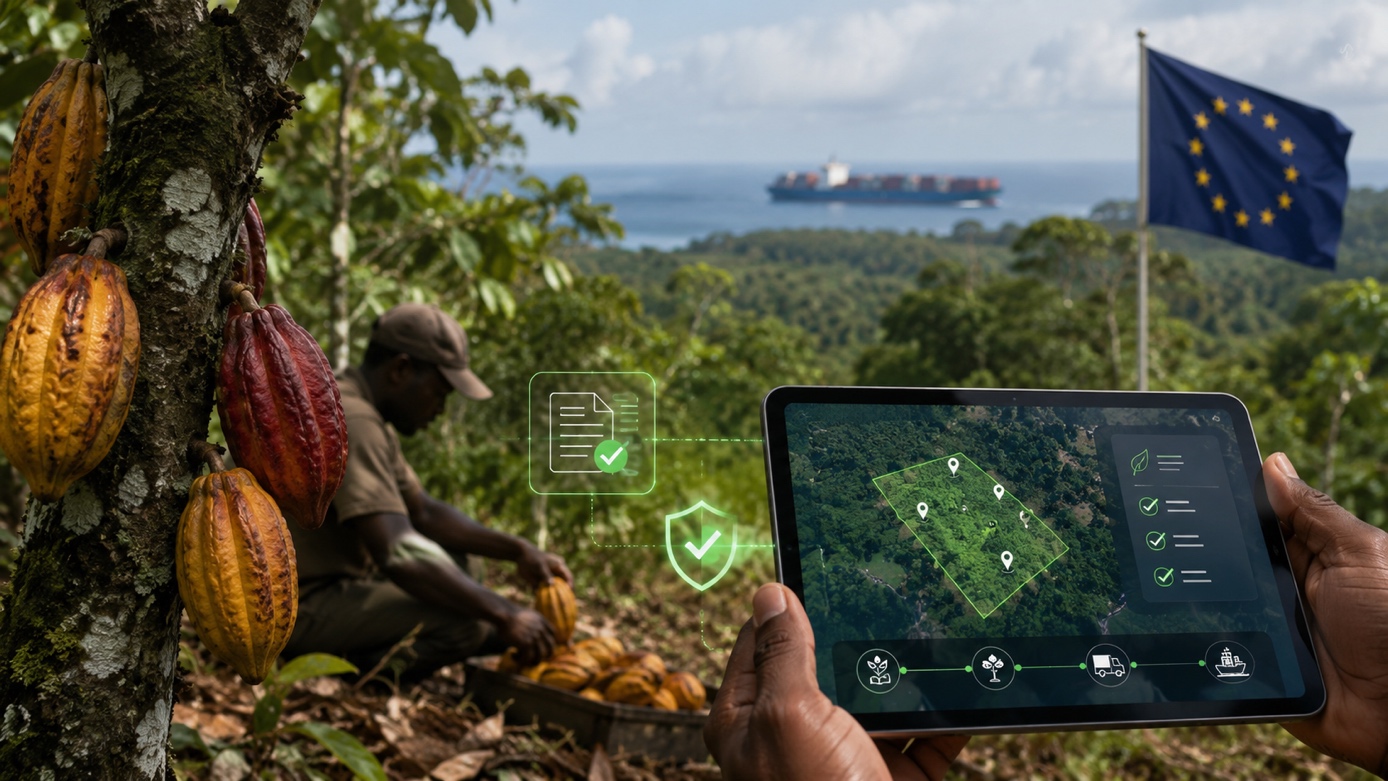
For three years, Ivory Coast's cocoa sector has lived under a deadline that keeps slipping. The European deforestation regulation was meant to apply at the end of 2024, then the end of 2025, and now it will finally apply at the end of 2026. In the end, many players have grown used to waiting for the next postponement.
But this time there won't be one. Five months remain.
The countdown has become real
The regulation will apply to large and medium operators from 30 December 2026, and from 30 June 2027 for micro and small enterprises. This timetable is the result of a second postponement decided at the end of 2025.
What sets it apart from the previous postponements is that the European Commission has now made up its mind. As recently as May 2026, it presented a package of simplification measures and confirmed that it would not reopen the text of the regulation. It is therefore imperative for companies to be ready for the December deadline.
For Côte d'Ivoire, the stakes are considerable. The European Union is by far the leading importer of Ivorian cocoa, with a record market share of 66.2% in 2024. The world's top producer is therefore staking two-thirds of its exports on this single text.
What the regulation requires
The principle is simple and fits in one sentence. A company selling cocoa on the European market must be able to demonstrate that its beans do not come from plots deforested after 31 December 2020, and must collect the information needed to geolocate those plots.
Three obligations follow from this simple principle.
- You must know exactly where each lot comes from, down to the plot.
- You must prove that the plot has not been deforested after the cut-off date.
- You must prove that production complies with the law of the country of origin, particularly regarding land tenure and the environment.
These three obligations apply with more or less intensity depending on the country's risk classification. Côte d'Ivoire is classified as "standard risk", which means that full due diligence applies without any relaxation.
What will actually happen in the sector
Now to the heart of the matter. The main Ivorian obstacle is not deforestation itself, but traceability.
An analysis published in May 2026 estimates that only 48% of the volume exported in 2024 could be traced back to cooperatives, and thus to a production department. The remaining 52% is untraceable, either because the cocoa passed through intermediaries (34%) or because traders did not disclose the identity of their suppliers (18%).
This may come as a surprise, because Côte d'Ivoire has made significant progress. According to the Coffee-Cocoa Council, more than 1.1 million producers had been registered as of 31 December 2025, nearly 900,000 producer cards distributed, and around 3 million hectares geolocated. The card will in fact become mandatory for any transaction from the opening of the main harvest, on 1 September 2026. This is not contradictory, however: mapping a plot and tracking a bag of beans are two different exercises. The Ivorian bottleneck is not the plot, it is what happens between the plot and the port.
In short, half of Ivorian cocoa now moves along paths that the European regulation no longer allows.
The most likely consequence is therefore not a general blockage of exports, but rather a split of the sector into two circuits. On one side, mapped, structured cooperatives, able to provide plot polygons and an unbroken traceability chain, which will keep their access to the European market. On the other, a diffuse circuit, running through trackers and middlemen, which will redirect toward non-European markets where traceability is not required.
This shift is taking shape against a backdrop of turning prices. The farmgate price, set at 2,800 FCFA/kg at the opening of the 2025-2026 main harvest, a record, fell to 1,200 FCFA for the intermediate harvest of March 2026, against 2,200 FCFA at the same period a year earlier. The Coffee-Cocoa Council attributes this drop to the collapse of international prices since December 2025. Producers are thus being asked to invest in their compliance at the very moment when prices are turning.
Proving compliance is not straightforward
Once a plot is geolocated, one might think verification is simple: you look at the satellite imagery before and after 2020, and you conclude. In reality, that is where the difficulties begin.
Let's start by defining what the regulation considers a forest, because it sets precise thresholds:
- An area of at least 0.5 hectares
- Tree cover above 10%
- Trees taller than 5 metres
The result: the answer depends on the map you use. The same plot can be classified as "forest" on one and "not forest" on another.
Then there is agroforestry. Cocoa grown under shade, encouraged by public policy for its environmental value, looks a lot like a forest from above. You therefore need to combine field data or LiDAR surveys with artificial intelligence to distinguish an agroforestry cocoa plot from a natural forest.
The consequence is very concrete. Take an agroforestry cocoa plot planted well before 2020, with large shade trees. Seen from above in 2020, it looks like a forest. If the farmer then thins the shade, which is part of normal maintenance, the automated comparison reads a loss of tree cover after the cut-off date and flags a deforestation. Yet nothing has been converted. The reverse also exists: cocoa established after 2020 under a partially preserved canopy barely changes the tree cover, and can therefore go unnoticed.
The cost is real: it is the exporter who carries the compliance declaration, and it is the producer who ends up excluded from a supply chain without having deforested anything at all.
This is precisely the problem TerraKora AI is addressing. We are building an independent verification layer based on multi-satellite datasets (radar, LiDAR, and optical imagery) coupled with our Alphakappa AI engine, capable not only of determining whether a plot is compliant but also of explaining variations in its biomass and carbon sequestration.
What remains to be done before December
Côte d'Ivoire is far from starting from scratch. According to the Coffee-Cocoa Council, more than 1.1 million producers had been registered as of 31 December 2025, nearly 900,000 producer cards distributed, and around 3 million hectares geolocated. The card will even become mandatory for any transaction from the opening of the main harvest, on 1st September 2026.
That is a solid foundation.
Three tasks remain open.
The first is to connect the indirect circuit. As long as half the flows pass through undeclared intermediaries, mapping the plots will not be enough: it is the links between the plot and the port that must be made visible.
The second is to make the proof reliable. Having a polygon does not mean having a demonstration of compliance. Verification must be reproducible, documented and defensible, because a European authority can contest it.
The third is to share the cost. Compliance cannot rest on producers alone, when the value created by traceable cocoa is captured downstream, at the buyer. The most serious avenue is to pay producers for a concrete environmental service, such as planting shade trees on their plots, financed through carbon markets. It is the least settled of the three questions.
Five months is not a long time for three tasks of this scale, yet Côte d'Ivoire already possesses a solid foundation, an unprecedented level of collective mobilization, and cutting-edge technologies. By reaching this milestone, the Ivorian sector has the opportunity to turn this regulatory requirement into a model, consolidating its position as a global leader through cocoa that is traceable, ethical, and creates sustainable value for its producers.