

For a long time, polluting was free. A factory could release CO₂ into the air without ever paying for the harm caused to the rest of society. The carbon market was created to fix exactly that. Here are its main principles, explained simply.
Why is there a carbon market?
CO₂ emissions are what economists call a negative externality: one actor's activity (the factory that pollutes) harms others (the society that suffers climate change), without the polluter paying for the damage. As a result, polluting was free, and nothing pushed companies to stop.
The carbon market puts a price on carbon. The emitter now has to pay for its pollution, and decarbonization becomes financially logical: if cutting emissions costs less than paying for its carbon, a company chooses to emit less.
At its core, this market turns CO₂, an invisible gas in the air, into a financial object that can be owned, counted, bought and sold.
The basic unit: the tonne of CO₂e
The chosen unit is the tonne of CO₂ equivalent (tCO₂e), the universal currency for all allowances and all credits.
Why the "e" for equivalent? Because CO₂ is not the only greenhouse gas: there is also methane, nitrous oxide, and others. Since they do not all have the same warming power, everything is converted back to CO₂ so that figures can be added up and life is made simpler for buyers and sellers alike. Methane, for instance, traps far more heat: a single tonne of methane is worth 28 to 30 tonnes of CO₂e on the market.
Two very different markets
There are two main carbon markets, and they work in completely different ways.
The compliance (regulated) market rests on legal obligation. States or institutions such as the EU require certain heavily polluting actors, cement plants or coal power stations, to take part. What is traded here are allowances, sometimes nicknamed "permits to pollute."
The voluntary (optional) market forces no one. Companies choose to buy credits of their own accord, to improve their image (CSR) or to claim a "Net Zero" target. What is traded here are carbon credits, in other words the financing of an environmental action already carried out on the ground.
The compliance market: cap and trade
The core mechanism is called cap and trade.
The cap is set by the regulator: the maximum amount of pollution allowed for the year. And that cap decreases every year. It is this programmed decline that ensures the environmental goal is ultimately met.
The trade happens in two stages. First the auctions (the primary market): the state no longer gives allowances away, it sells them. Then the secondary market, where companies trade allowances among themselves: the one that emits little sells its surplus, the one that exceeds its limit has to buy more.
Because the cap falls year after year, carbon becomes scarcer, its price rises, and that increase pushes companies to decarbonize. Some systems add safeguards. California, for example, sets a floor price to keep the market from collapsing, a floor that rises by 5% plus inflation each year, allowing companies to plan ahead. The money raised at auction is then reinvested into social and environmental projects: this is known as cap and invest.
The voluntary market
Here, no one is obliged: companies buy credits willingly, to offset their residual emissions as part of a Net Zero or CSR approach.
To be sellable, credits must be certified by global standards such as Verra or Gold Standard. The price is free and varies enormously, from $2 to over $100, depending on the project's real impact. Once sold to a company, a credit is retired from the market to prevent double counting, that is, to stop it from being sold to two buyers.
It is precisely this market that finances projects on the ground: forests, clean energy, agriculture.
What exactly is a carbon credit?
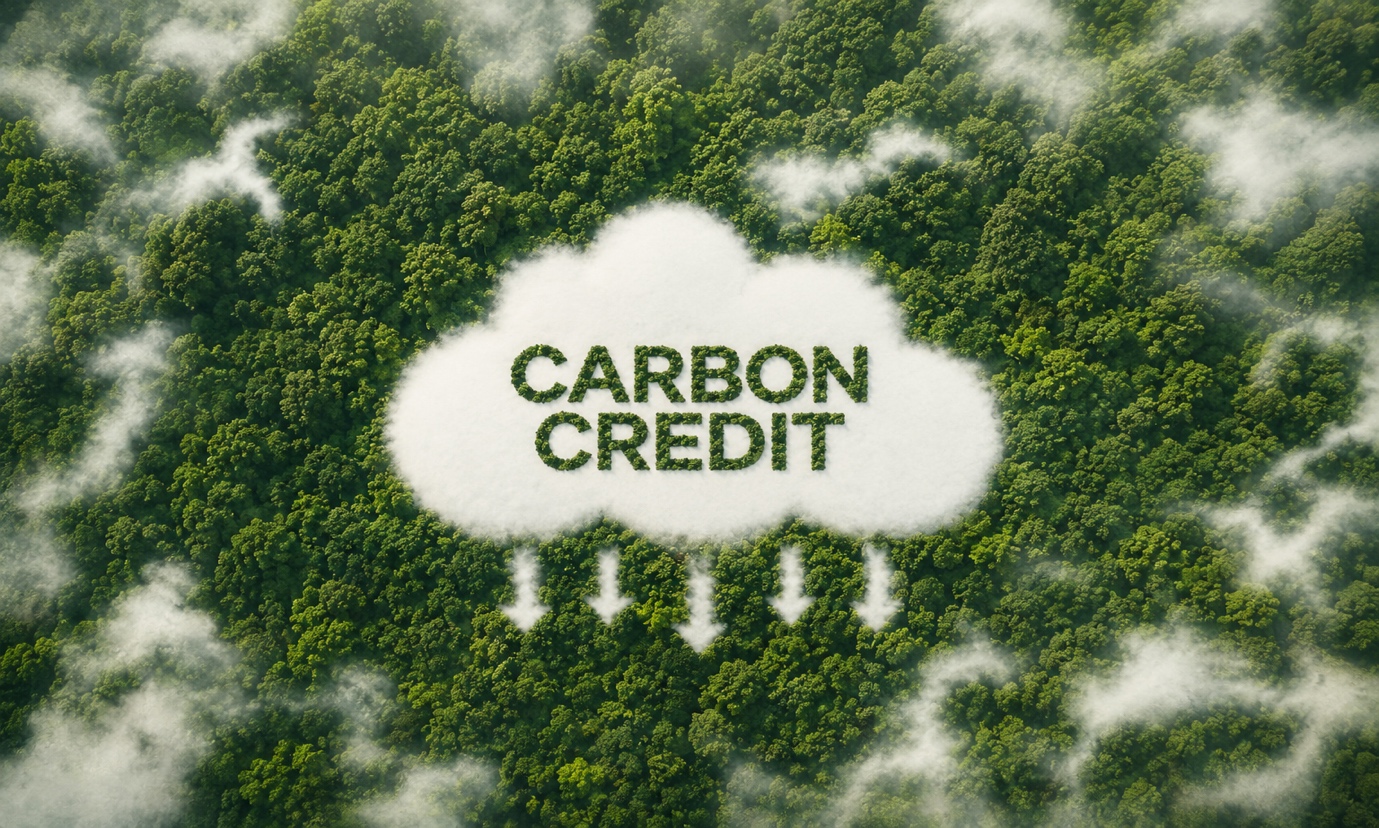
A carbon credit corresponds to one tonne of CO₂ avoided or removed, certified by an independent standard. Either a tonne that is not released into the atmosphere, or a tonne taken out of it.
Three criteria give it its value.
Additionality first: it must be proven that the reduction would not have happened without the project, otherwise you are paying for nothing.
Permanence next: the reduction has to last, because a forest that is protected and then burns cancels out the entire benefit; the durability of the storage must therefore be guaranteed.
Verifiability last: the amount of CO₂ avoided or removed must be measurable and checkable by an independent third party before being validated and recorded in the registry.
There are, moreover, two ways to generate a credit. You can avoid or reduce emissions that would otherwise have occurred, by protecting a threatened forest or replacing a coal plant with solar: the carbon then stays where it is. Or you can remove or sequester CO₂ already present in the air, by planting a forest or capturing carbon: the carbon is then pumped back out.
One point of caution: for a credit to be validated, it must be shown that the money it generates is genuinely necessary to the project, and that without it the project would not have happened.
How credits are generated: nature versus technology
Some solutions are based on nature. Forests, or REDD+, involve avoiding deforestation and forest degradation (an avoidance strategy). Reforestation replants trees that sequester carbon as they grow (a removal strategy). Soil carbon relies on regenerative agriculture that stores carbon in the ground, hard to set up and to measure (removal). Blue carbon, finally, restores mangroves and coastal ecosystems, which store huge amounts of carbon, but whose measurement is very difficult, whose permanence is undermined by warming, and which are often burdened by land disputes (removal).
Other solutions are based on technology. Renewable energy replaces fossil generation with wind or solar (avoidance). Clean cooking changes household cooking methods to cut wood consumption (avoidance). Capture and storage capture CO₂ at the source or from the air and store it away (removal). Methane capture recovers methane from landfills, biogas or livestock (avoidance).
The REDD+ mechanism
REDD+ stands for Reducing Emissions from Deforestation and forest Degradation. It is a UN framework that rewards countries that reduce their deforestation.
The principle: a reference scenario is defined (the deforestation expected without intervention), then credits are generated on the gap with observed reality. In other words, a credit corresponds to the gap between the reference and reality. Hence a crucial point: the value of the credits depends entirely on the rigor of the reference scenario and the reliability of the measurements taken in the real world.
Article 6 of the Paris Agreement
Article 6 sets the rules that allow countries and companies to trade emissions reductions internationally.
Article 6.2 lets two countries strike bilateral deals: one country sells its reductions to another, which counts them toward its national target. These are no longer called credits but ITMOs (Internationally Transferred Mitigation Outcomes). In practice, one country develops an environmental project financed by another, which takes the ITMOs to count toward its own national climate targets. Dozens of such deals already exist, between Singapore or Switzerland and countries in Africa or the Pacific.
Article 6.4 succeeds the Clean Development Mechanism of the Kyoto Protocol. It creates the PACM, a centralized market supervised by the UN: any company or private developer can submit a project to a UN oversight body, and if it is approved, it generates official UN credits, which can be bought by states, companies, or airlines through CORSIA.
Finally, to prevent fraud, Article 6 imposes the corresponding adjustment: when a country sells a reduction, it must remove it from its own books. Without this system, the same tonne would be counted twice.
Who certifies, who verifies?
To avoid greenwashing, the system relies on a strict separation of powers: the developer cannot evaluate itself, and the regulator does not audit the field itself. Three distinct roles share the work.
The certifiers set the rules and write the scientific methodologies. They keep the official registry of credits and give each one a unique serial number to prevent double sales. They are organizations independent of governments, such as Verra, Gold Standard or Plan Vivo.
The verifiers (VVBs) are independent third parties that audit the project. They do not write the rules, they enforce them: they first check the design (is the project viable and realistic?), then the results (did the trees grow? how much carbon was stored? was deforestation actually avoided?), on the ground or by satellite. These are large accredited international audit firms such as SGS, Bureau Veritas or TÜV Nord.
The regulators set the political and legal framework: setting climate targets, monitoring compliance, enforcing treaties, imposing penalties. They are public or supranational bodies: the EU or the state (as in California) on the compliance market, the UN for Article 6.4 and CORSIA.
MRV: measure, report, verify
An emissions reduction only becomes a sellable credit after passing through MRV (Measurement, Reporting, Verification). It begins with measuring the carbon stocks, using satellites, LiDAR, field surveys and AI. Then comes reporting, through standardized, transparent and traceable reports. Which finally allows verification, by an independent third party: the step that unlocks the issuance of credits.
In conclusion
The carbon market is, at heart, a vast system of trust. It turns an invisible tonne of CO₂ into an asset that can be bought and sold, but that asset is worth nothing if you cannot prove it is real. Additionality, permanence, verifiability, separation of powers, corresponding adjustment: all these safeguards answer one and the same question, can this tonne be trusted? That is where a credit's entire credibility is decided.
TerraKora AI builds the measurement and verification infrastructure that makes that trust possible, starting in Côte d'Ivoire. Book a meeting to talk with the team.